News & Information
Home > News > Article Detail
As a consultant who’s walked through hundreds of commercial kitchens over the last decade, I’ve seen it all: from bustling Michelin-starred operations to single-wok street stalls. The common thread for success, regardless of scale, is efficiency and consistency. And when it comes to a menu staple like fried rice, these two factors can make or break your profit margins.
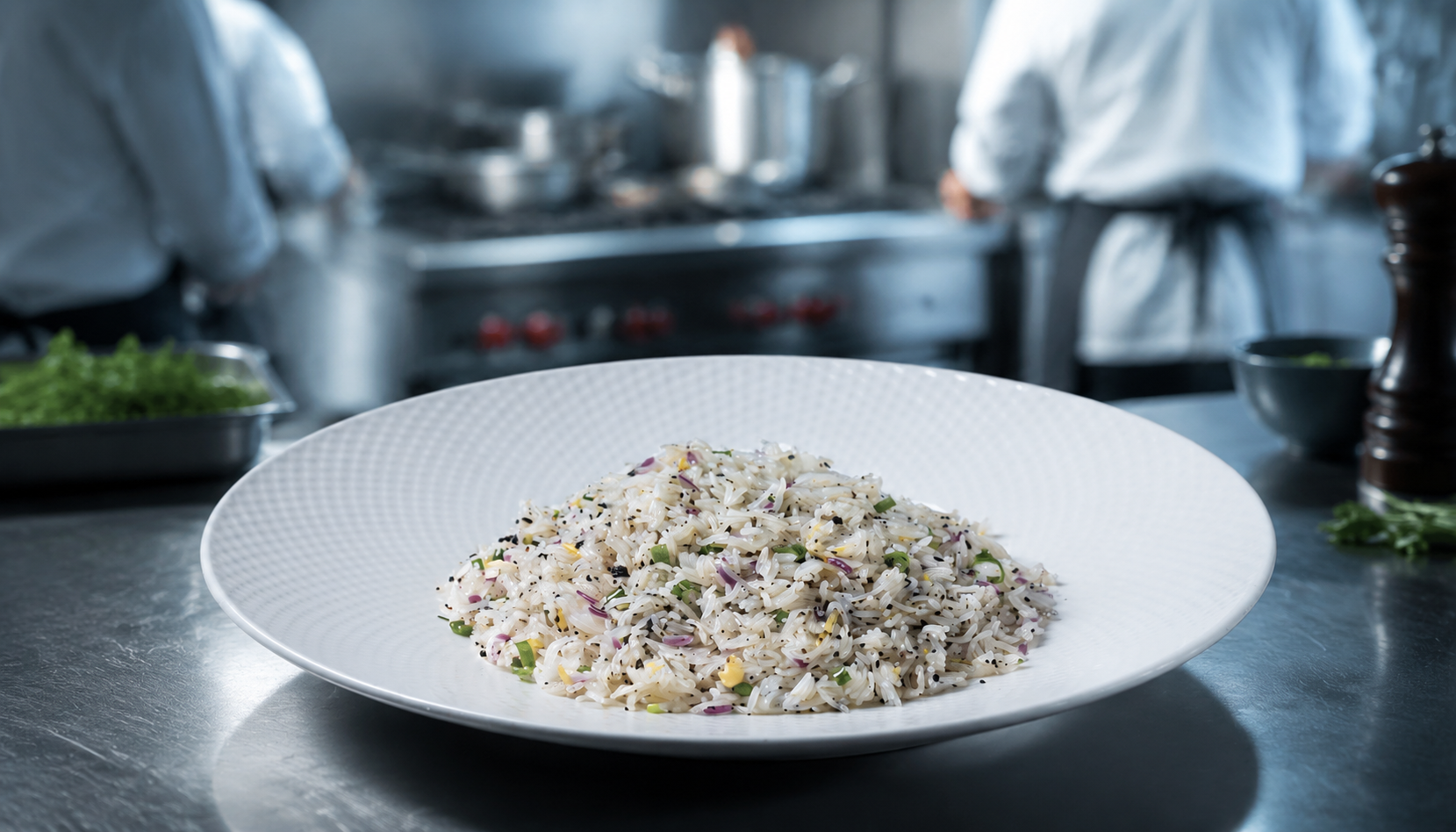
Today, we're cutting straight to the chase about a product that many operators overlook as a simple commodity: rice. Specifically, the Nian Nian Feng Tri-color Fried Rice 10kg. This isn't just another bag of rice; it's a strategic ingredient designed to solve real operational headaches. We're talking about fragrant glutinous grains that are plump, easy to cook, and crucially, each grain remains distinct – the holy grail for perfect fried rice. Whether you're a high-volume commercial kitchen or a home chef aiming for restaurant quality, understanding its impact is key.
Many restaurant owners choose generic white rice based solely on per-kilogram price. Let's break down why this often leads to higher total costs.
Consider a restaurant serving 200 portions of fried rice daily, using approximately 150g of cooked rice per portion. That’s 30kg of cooked rice per day. Assuming a 2.5:1 cooked-to-raw yield ratio (which is generous for generic rice), you're looking at 12kg of raw rice daily. Over a 30-day month, that’s 360kg of raw rice.
Scenario 1: Generic White Rice (e.g., $1.50/kg)
Monthly Raw Material Cost: 360kg $1.50/kg = $540.
* Preparation Overhead: Generic rice often requires extensive pre-soaking, careful water ratios, and often, an overnight refrigeration step to dry out the grains sufficiently for frying. This adds a minimum of 30-45 minutes of prep time for a kitchen assistant daily. At an average wage of $15/hour, that's an extra $7.50-$11.25 per day, or $225-$337.50 per month in direct labor just for rice prep.
* Cooking Inconsistency & Rework: Generic rice, especially if not perfectly cooled, tends to clump. This means cooks spend more time breaking up lumps in the wok, potentially burning some grains or leading to uneven texture. A new cook might add 15-20 seconds per portion. For 200 portions daily, that’s 50-66 minutes of extra cook time. At $20/hour for a line cook, that's $16.67-$22 per day, or $500-$660 per month in wasted cook time.
* Food Waste: Clumpy, poorly fried rice often gets sent back, or is simply not up to standard, leading to waste. Let's conservatively estimate 3% waste due to quality issues. That's 10.8kg of rice wasted per month, costing an additional $16.20.
Total Estimated Monthly Cost (Generic Rice): $540 (material) + $280 (prep labor) + $580 (cook labor inefficiency) + $16.20 (waste) = $1,416.20.
This doesn't even account for the lost revenue from slower service or customer dissatisfaction due to inconsistent quality. As highlighted in Chongqing, Hangzhou, Guangzhou: A Fried Rice Odyssey, the standard of fried rice deeply impacts a restaurant's reputation.
Now, let's look at how a specialized product like Nian Nian Feng Tri-color Fried Rice 10kg changes the equation. This particular blend is engineered for fried rice: the grains are robust, release less starch, and stay separate even when cooked quickly. This makes it an 'easy to cook' option that delivers 'distinct grains' with a 'fragrant and glutinous' texture.
Scenario 2: Nian Nian Feng Tri-color Fried Rice 10kg (e.g., $2.50/kg)
Monthly Raw Material Cost: 360kg $2.50/kg = $900. (Initially looks higher, right? Keep reading).
* Preparation Efficiency: This rice typically requires minimal to no pre-soaking and can be used immediately after cooling from steaming (usually 30-45 minutes). The 'easy to cook' nature means no overnight refrigeration is strictly necessary to achieve distinct grains. This eliminates the daily 30-45 minute prep task. Savings: $225-$337.50 per month.
* Cooking Efficiency: Because the grains are naturally 'distinct grains' and less prone to clumping, even new cooks can achieve a high-quality product. This reduces the average cooking time per portion by 10-15 seconds. For 200 portions daily, that’s 33-50 minutes of cook time saved. Savings: $11-$16.67 per day, or $330-$500 per month. This directly translates to faster output during peak hours; saving 10 seconds per order means you can push out an extra 10-15 orders during a busy lunch rush, boosting revenue.
* Reduced Waste & Consistency: The inherent quality and ease of use drastically reduce the chance of failed batches. Let's assume waste drops to a negligible 0.5%. That's 1.8kg of rice wasted per month, costing $4.50. Savings: $11.70 per month.
Total Estimated Monthly Cost (Nian Nian Feng Tri-color Fried Rice): $900 (material) + $0 (prep labor) + $0 (cook labor inefficiency) + $4.50 (waste) = $904.50.
Monthly Savings: $1,416.20 (Generic) - $904.50 (Nian Nian Feng) = $511.70 per month.
Annual Savings: $511.70 * 12 = $6,140.40.
This calculation clearly demonstrates that focusing solely on the per-kilogram price of rice is a false economy. The total cost of ownership, factoring in labor, efficiency, and waste, makes a product like Nian Nian Feng Tri-color Fried Rice 10kg a superior investment.
One of the biggest advantages of using a specialized rice like Nian Nian Feng is the ability to standardize your fried rice production, ensuring 'excellent texture' and 'golden, appetizing' results consistently. Here's a simplified SOP:
Nian Nian Feng Tri-color Fried Rice SOP:
1. Rice Measurement: For each batch, accurately measure 150g of Nian Nian Feng Tri-color Fried Rice 10kg per portion. For bulk cooking, use a consistent volumetric measure or scale.
2. Washing: Rinse rice 2-3 times until water runs mostly clear. This removes excess starch, further aiding grain separation.
3. Water Ratio: Use a precise rice-to-water ratio of 1:1.1 by volume or weight for steaming. This ensures optimal moisture absorption without making the rice mushy.
4. Steaming/Cooking: Steam or cook the rice in a commercial rice cooker according to manufacturer instructions. Ensure the rice is fully cooked but still firm.
5. Cooling & Resting: Immediately after cooking, spread the hot rice thinly on large, flat trays (e.g., sheet pans). Allow it to cool at room temperature for 30-45 minutes, or until it reaches ambient temperature. This step is crucial for achieving 'distinct grains' and can be done without overnight refrigeration, unlike generic rice. Avoid covering the rice during cooling to prevent condensation.
6. Portioning (Optional): Once cooled, portion the rice into individual serving sizes (150g) in containers or bags for quick access during peak hours. This ensures 'standardized' output.
7. Frying: Use a hot wok with sufficient oil. Add cooled rice and stir-fry vigorously. The Nian Nian Feng rice will naturally separate, allowing for a quick and even fry, creating 'golden, appetizing' fried rice with 'excellent texture'.
This SOP streamlines the process, reduces variability between cooks, and ensures that every plate of fried rice meets your quality standards. It also addresses the stickiness problem effectively, as discussed in fried-rice-sticky-this-10kg-bag-is-the-secret-mp5eb64t0.
Let's consider 'Wok Master Bistro,' a busy urban eatery specializing in stir-fries, serving an average of 180 fried rice dishes daily. Before 2026, they used a popular local medium-grain white rice, priced at $1.60/kg. Their kitchen manager, Mr. Chen, reported several issues:
* Prep bottleneck: Two hours daily were spent by junior staff managing rice prep (washing, steaming, cooling, often overnight refrigeration). This tied up labor that could be used for vegetable prep or mise en place.
* Inconsistent output: New cooks struggled to get the rice 'fluffy' and 'distinct,' leading to 10-15% of fried rice orders needing rework or being subpar, especially during lunch rush.
* Slow service: Each fried rice order took an average of 2 minutes to cook, including breaking up clumps. During peak lunch (12-2 PM), they could only manage 40-45 fried rice orders per hour, losing potential sales.
In early 2026, Mr. Chen switched to Nian Nian Feng Tri-color Fried Rice 10kg after a trial. Here are the documented changes:
Prep time reduced: Prep time for rice dropped to 45 minutes daily. The rice could be cooked and cooled in the morning for same-day use, freeing up the junior staff for other tasks immediately. Labor savings: 1.25 hours/day $15/hour = $18.75/day, or $562.50/month.
Quality consistency: The 'distinct grains' and 'easy to cook' nature meant even new recruits achieved near-perfect results after minimal training. Rework dropped to under 2%. Waste reduction: Approx. 8% of 180 servings/day 150g/serving = 2.16kg/day saved, approx. $5.40/day or $162/month.
* Faster cooking: Cooks found the rice much easier to handle, cutting average cook time to 1 minute 40 seconds per portion. During peak hours, they could now comfortably handle 55-60 fried rice orders per hour. Increased capacity: 10-15 additional orders per hour, potentially adding $100-$150 in revenue during peak lunch alone, or $3000-$4500 monthly.
Mr. Chen noted that while the initial per-kilogram price of the Nian Nian Feng rice was higher, the overall operational savings and revenue boost far outweighed the material cost difference. The ability to achieve 'restaurant quality aromatic rice' consistently without extensive training was a game-changer.
While the Nian Nian Feng Tri-color Fried Rice 10kg is ideal for mid-to-high volume commercial use, Niannianfeng offers other options. For smaller establishments or even home chefs looking to experiment with this specific fried rice quality, the Niannianfeng Fried Rice Special Rice 5KG Family Pack Non-Stick Grains Separate Restaurant Quality Aromatic Rice offers a more manageable quantity. And for individual trials or dormitory singles, the Niannianfeng Rice 500g Small Pack Rice for Dormitory Singles, Convenient for First Taste allows for a low-commitment entry point to experience the quality.
Ultimately, making smart procurement decisions isn't just about the sticker price. It's about calculating the total impact on your operations, from labor and efficiency to waste and customer satisfaction. The right rice, like the Nian Nian Feng Tri-color Fried Rice, isn't an expense; it's an investment in your kitchen's productivity and your restaurant's bottom line.